Cart
0
Table of Contents
- Home Furnishing and Accessories: What Actually Belongs in Your Space
- Furniture Collections and Accent Pieces That Anchor a Room
- How to Style Home Accessories Without Cluttering the Room
- Modern Home Decor Trends Worth Following in 2026
- Functional Home Decor Ideas for Small Spaces and Renters
- Sustainable Sourcing and Color Palette Coordination
- Conclusion: Building a Home That Reflects You
- Frequently Asked Questions
Last Updated: October 6, 2026
Home Furnishing and Accessories: What Actually Belongs in Your Space
Home furnishing and accessories is the practice of selecting and arranging a room's functional and decorative elements, from large furniture down to textiles and lighting, so the space works for daily life and looks intentional.
That system starts with one principle: every piece should earn its place by doing at least one job well, storage, lighting, comfort, or visual anchoring. A room built on that principle feels calm; one built on impulse purchases feels cluttered.
This guide covers furniture collections, accent pieces, styling rules, 2026 trends, small-space solutions, and how to source and coordinate color responsibly.
Key Takeaway
A room feels finished when every piece has a job. Before buying anything, name the job it will do: storage, light, texture, or anchor. If you cannot name one, skip it.
Furniture Collections and Accent Pieces That Anchor a Room
Anchoring a room means giving the eye a clear place to land: one substantial piece per zone, with smaller accents arranged around it rather than competing with it.
The biggest mistake is treating every piece as equally important. When a coffee table, side table, floor lamp, and bookshelf all demand attention, the room reads as noisy.

For living rooms, the anchor is usually the media or seating piece. Our White TV Stand for Living Room is built for exactly this role: an 83-inch-wide footprint that fits flat screens up to 90 inches, four full-size drawers, and a waterproof RGB light strip that adds ambient glow without a separate lamp.

If your space leans darker or warmer, the 70-inch black TV stand with two drawers and four storage compartments offers the same anchoring logic in a more compact frame.

Accent pieces do the softer work: a textured throw, a ceramic vase, a stack of books, one good lamp.
Pro Tip
Buy your anchor piece first and live with it for a week before buying anything else. Your eye adjusts to the scale of the room, and you will instinctively know which accents are the right size. Most people buy accents first and then hunt for a sofa that fits around them. That is backwards.
How to Style Home Accessories Without Cluttering the Room
Styling home accessories without clutter comes down to three rules: group in odd numbers, vary height, and leave negative space.
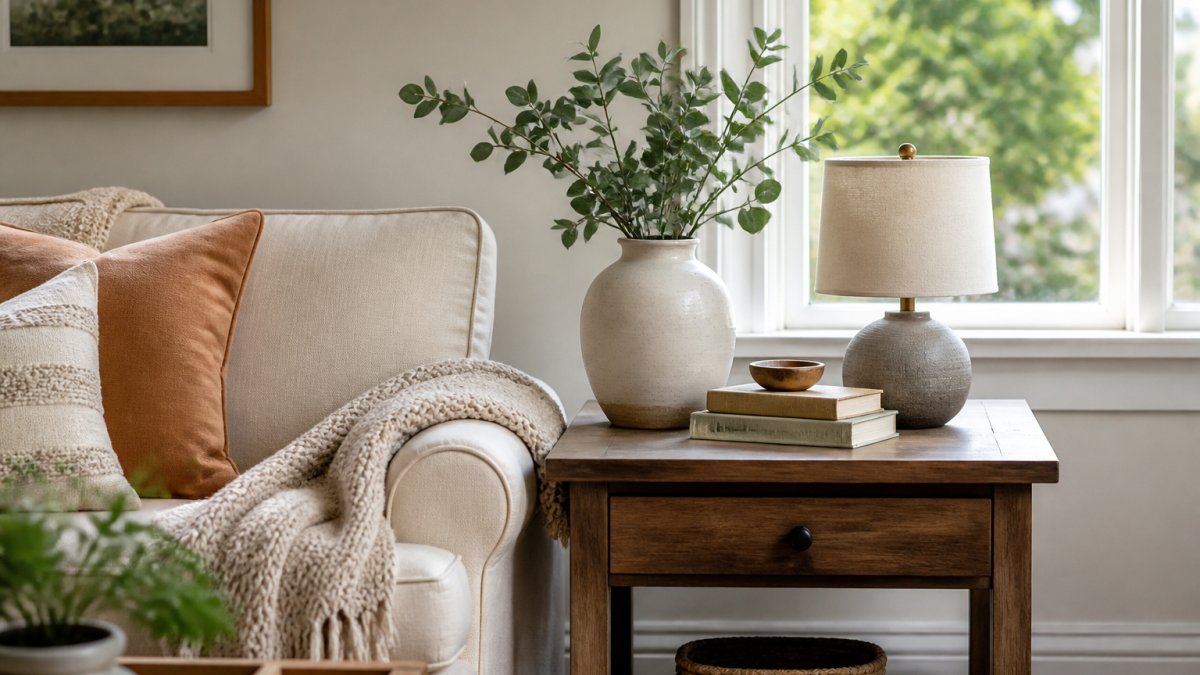
Start with a base layer covering most of the surface, like a tray or runner, so smaller objects read as one grouping. Then add one tall element, one medium, and one small, that triangle is the whole trick.
Here is the sequence we recommend:
- Clear the surface completely and wipe it down.
- Place the largest object off-center, roughly one-third from one edge.
- Add a second object at a different height, overlapping the first slightly.
- Add a third small object for texture or color.
- Step back three meters and check whether anything looks crowded. Remove one item if it does.
That last step matters most: an over-styled surface often has one object too many.
Modern Home Decor Trends Worth Following in 2026
Modern home decor trends in 2026 lean toward warmth and lived-in texture rather than the cool minimalism of recent years. Warmer neutrals, natural materials, layered lighting, and honest craft are where most designers are moving. Three trends are worth your attention:
- Warm minimalism. Fewer pieces, but each one with visible texture: raw wood, linen, unglazed ceramic. The palette stays neutral but the surfaces are not flat.
- Layered lighting. One overhead light is out. Two or three light sources at different heights, including a low ambient source like an LED strip or a small table lamp, create depth.
- Sculptural furniture. Curved edges, rounded corners, and asymmetric shapes are replacing hard rectangles. A coffee table with a puzzle-cut top, for example, reads as a piece of design rather than just furniture.
That last point is where our coffee table with four hidden storage compartments fits the trend. Its square top is divided into five sections by four lines, and the four outer sections slide open in different directions to reveal hidden storage.
Trends are a filter, not a rulebook. If a trend does not fit how you actually live, skip it, a home that reflects you always looks better than one that reflects a mood board.
Functional Home Decor Ideas for Small Spaces and Renters
Most small-space advice stops at "buy multifunctional furniture." That is not a plan.
Start with a room audit.
Here is how to choose pieces that work in a rental without drilling a single hole:
White TV Stand For Living Room, Modern Entertainment Center Stand For TV Up →
- Closed storage over open shelving. Open shelves display clutter in small rooms. A low console with doors or drawers hides the daily mess and reads as furniture, not storage. Look for units under 30 inches tall so they do not visually cut the room in half.
- Freestanding lighting. You cannot rewire a rental, so replace the ceiling fixture with a floor lamp or a plug-in wall sconce. A lamp with a warm bulb at eye level makes a room feel larger than a bright overhead light because it creates pools of light instead of flattening everything.
- Pieces that move. A nesting side table, a folding desk, or a coffee table with casters can be reconfigured when guests arrive or when you move. Fixed-footprint furniture is the enemy of a rental.
- Vertical storage that leans. A ladder shelf or a leaning mirror adds height and function without wall anchors. Just secure the top with a furniture strap if you have kids or pets.
- Rugs to define zones. In a studio, a rug under the seating area and a separate runner in the kitchen visually separates functions without a wall. Choose a low-pile rug in a rental so it cleans easily and does not trap dust.
Measure three dimensions before buying: wall length, walkway width, and the doorway the piece must pass through.
Renters should also check the lease for restrictions on wall anchors, adhesive strips, and outdoor furniture.
One more mechanism: use the back of doors. An over-the-door organizer or slim hanging shoe rack adds storage without floor space, and a second closet rod or stackable shelf insert does the same.
Pro Tip
Before buying any small-space piece, tape its footprint on the floor with painter's tape and live with it for two days. You will immediately see whether it blocks a walkway or crowds a door swing. This one step prevents most returns.
If you are coming from a larger home, expect to buy fewer, better pieces. Small spaces reward precision, not volume: one well-scaled console with closed storage does more than three open shelves and a decorative cart.
Sustainable Sourcing and Color Palette Coordination
Sustainable sourcing and color coordination are usually treated as separate topics. They are not. Both are about buying fewer things and making sure each one lasts and fits.
On sourcing, ask four questions before any purchase:
- What is it made from? Look for solid wood, metal, glass, or certified composite panels. Avoid vague labels like "engineered wood" unless the product page specifies the core material and the finish. A waterproof, easy-clean surface on a certified particleboard core can outlast a cheap solid-wood piece that warps in humidity.
- How long will it last? Check the weight capacity, the hardware (metal drawer glides vs. plastic), and whether the finish is repairable. A console rated for 200 pounds with metal glides will outlast one rated for 80 pounds with plastic tracks.
- Can it be cleaned and repaired? Removable cushion covers, replaceable legs, and touch-up markers extend life. Furniture that cannot be cleaned is furniture that gets thrown away.
- Where was it made and by whom? This is the hardest to verify. Look for brands that publish factory information or hold third-party certifications. Treat "sustainable" as a claim to verify rather than a label to trust. The U.S. Environmental Protection Agency's guidance on sustainable materials management explains how material choice affects a product's lifespan and end-of-life impact, which is a useful frame for judging furniture claims.
A practical trade-off: recycled or reclaimed materials often have a lower environmental footprint but inconsistent color and texture.
On color, the safest approach is a 60-30-10 split: 60 percent of the room in a dominant neutral, 30 percent in a secondary tone, and 10 percent in an accent.
Here is how to apply it without guessing:
- Pick the dominant tone from something you cannot change. If your rental has warm oak floors, your 60 percent should be a warm neutral that harmonizes with that wood, not a cool gray that fights it. If your floors are cool gray, lean into cooler neutrals.
- Choose the secondary tone from your largest textile. A rug or sofa in a mid-tone sets the 30 percent. This is where you add depth without competing.
- Use the accent for one repeatable element. A saturated cushion, a vase, or a piece of art. Repeat the accent in at least two places in the room so it reads as intentional rather than random.
- Test the palette in the actual light. Paint a large swatch or hold fabric samples against the wall at morning and evening. Color shifts dramatically between natural and artificial light.
Texture follows the same logic.
| Element | Share of Room | Example | What It Does |
|---|---|---|---|
| Dominant tone | 60% | Warm off-white walls, large neutral furniture | Sets the base and calms the space |
| Secondary tone | 30% | Wood tones, mid-tone textiles | Adds depth without competing |
| Accent | 10% | One saturated cushion, vase, or artwork | Draws the eye and adds personality |
Best For
Renters and small-space dwellers who need pieces that move with them, hide clutter, and never require a permanent installation.
When sourcing and color work together, you buy less. One well-chosen console in a color that harmonizes with your floors and a material that wipes clean will outlast three trend pieces, the practical version of sustainable furnishing.
Conclusion: Building a Home That Reflects You
The hardest part of furnishing a home is not finding beautiful pieces. It is resisting the urge to buy them all at once. Rooms that feel finished are built slowly, one anchor piece at a time, with each addition earning its place.
At Domicile Digs, we curate home essentials with that slower approach in mind: a thoughtfully selected range of furniture, lighting, outdoor accents, and smart home devices, all chosen for timeless style and everyday function. Our white TV stand with four storage drawers and waterproof RGB lighting anchors a living room and hides the clutter.
Start with one piece. Add to Cart when it is the right one, not when it is on sale.
Frequently Asked Questions
What is the difference between home furnishings and home accessories?
Home furnishings are the larger, structural pieces that define a room's function: sofas, TV stands, coffee tables, beds, and dining sets. Home accessories are the smaller decorative and functional items layered on top, such as wall art, textiles, lighting fixtures, and accent pieces. Furnishings set the layout; accessories set the mood. Most rooms need both to feel complete, and starting with furnishings before adding accessories keeps the space from feeling cluttered or disjointed.
How do you choose the right home accessories for your style?
Start with a color palette of two to three core tones, then pick accessories that repeat those colors across different textures. If your style leans modern, choose clean lines and matte finishes; for a warmer look, mix in woven textiles and natural materials. A practical rule is to pick one statement piece per surface, like a sculptural lamp or a bold vase, and keep the rest understated. Layering texture is what makes accessories feel intentional rather than random.
What are some popular home decor styles for modern living?
Modern home decor trends in 2026 favor warm minimalism, which pairs neutral bases with natural wood, stone, and soft textiles. Other popular styles include Japandi, a blend of Japanese simplicity and Scandinavian comfort, and curated eclectic, where vintage finds sit alongside contemporary pieces. Color schemes lean toward earthy greens, warm terracottas, and soft creams. The common thread is fewer, better pieces that serve a purpose rather than rooms packed with decorative accessories.
How can smart home devices integrate with traditional furnishings?
Smart home devices work best when they blend into your existing decor rather than stand out. Look for lighting fixtures with built-in smart controls, LED strips that attach to furniture like TV stands, and smart plugs that turn any lamp into an app-controlled light. Choose devices that match your room's finish and color so they read as part of the design. Before buying, check that the device works with the platform you already use, and confirm the return policy in case integration does not go smoothly.