Cart
0

Table of Contents
- Why Everyday Home Environments Shape How You Live
- Home Lighting Ideas That Change the Mood of a Room
- How to Create a Cohesive Home Design Across Every Room
- Affordable Home Decor Ideas That Still Look Considered
- Room-by-Room Interior Design Tips for Real Homes
- Functional Zoning, Space Planning, and Small-Space Solutions
- Budget Tiers and Phased Improvements for Your Home Environment
- Conclusion
- Frequently Asked Questions
Last Updated: October 21, 2026
Why Everyday Home Environments Shape How You Live
Your home environment is the physical and emotional backdrop of your daily life, and small design choices compound into how you feel, focus, and rest.
Comfort, functionality, and the daily routine are the three legs of the stool. A Harvard T.H. Chan School of Public Health overview of healthy home environments makes the broader point well: housing conditions shape health and well-being in measurable ways, from air quality to light exposure.
Comfort, Functionality, and the Daily Routine
Start with what you do in a room, not what you want it to look like. Where do you drop your keys? Where does the laptop land at 9pm? Those two spots dictate more of your layout than any mood board.
- Comfort is temperature, seating depth, and softness underfoot.
- Functionality is storage within arm's reach of where things get used.
- Routine is the path you walk every morning. If furniture blocks it, the room fights you daily.
A common mistake is buying the statement piece first and squeezing the practical pieces around it. Do the reverse.
Home Lighting Ideas That Change the Mood of a Room
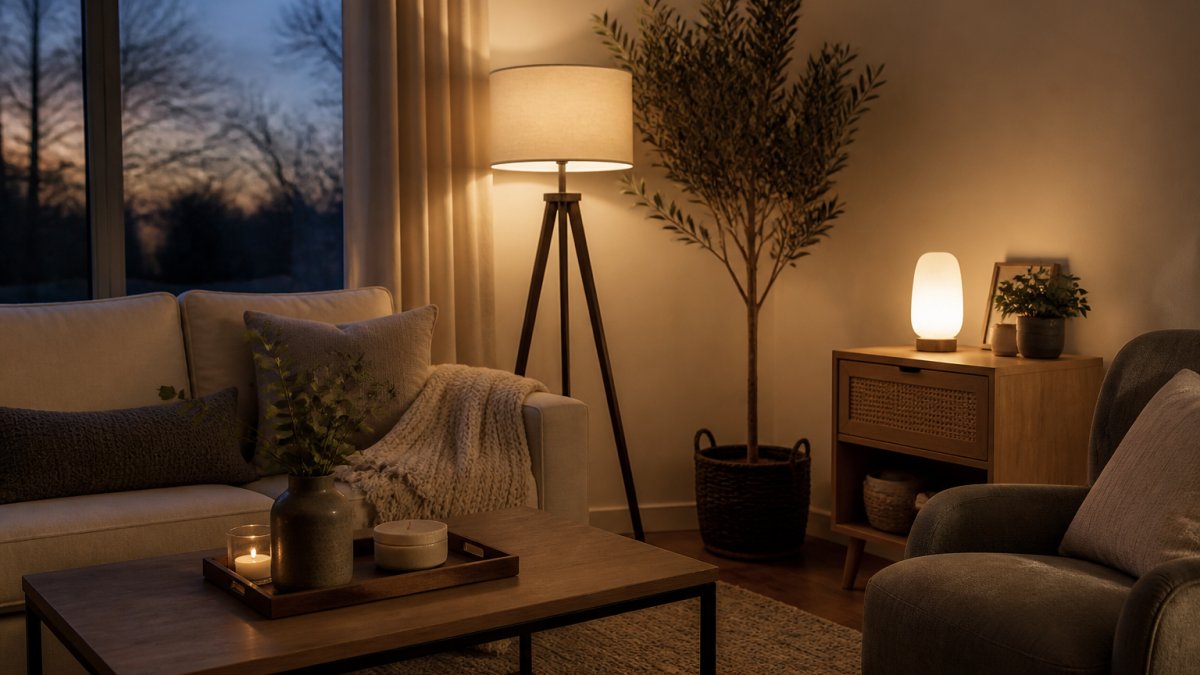
Home lighting ideas work best when you treat light as three separate jobs: ambient, task, and accent. Most rooms fail because they only have the first one, usually a single overhead fixture that flattens everything.
Layering Natural Light and Artificial Light
Begin with daylight. Keep window sills clear, use sheer curtains rather than heavy blocking ones during the day, and place mirrors to bounce light deeper into the room. Then build artificial layers on top:
- Ambient: one soft overhead or ceiling wash, dimmable if possible.
- Task: a focused source where you read, cook, or work.
- Accent: low-level warmth at the edges of the room.
The Domicile Digs LED nightstand is a good example of accent lighting doing real work: its color and brightness are adjustable by remote or app, so the same piece can be a bright reading companion or a dim glow at bedtime. Warm bulbs in the 2700K range generally feel calmer in living and sleeping spaces, while cooler light suits kitchens and workspaces.

Pro Tip
Put every lamp on its own switch or smart plug rather than one wall switch for the whole room. Being able to turn off the overhead and leave two corners glowing is the single biggest mood upgrade in most homes.
How to Create a Cohesive Home Design Across Every Room
Learning how to create a cohesive home design comes down to repetition with variation. Pick a small palette, a consistent metal finish, and one or two repeated shapes, then let each room interpret them differently.
The practical method:
- Choose two neutrals and one accent color. Use the accent sparingly in every room.
- Repeat one material at least three times across the home, such as oak, black metal, or natural linen.
- Keep flooring and wall tones flowing between adjacent rooms rather than stopping hard at a doorway.
What most guides miss is that cohesion is about relationships, not matching sets. A walnut and oak coffee table in the living room and a pair of wooden nightstands in the bedroom read as a family even though they are different pieces, because the wood tones and splayed legs echo each other.

Affordable Home Decor Ideas That Still Look Considered
Affordable home decor ideas succeed when the money goes to the pieces you touch and look at closely, and the savings come from the pieces nobody inspects. A canvas art print at an entry-level price can carry a wall if the frame and placement are right.
Where to spend and where to save:
- Spend: seating you use daily, lighting you look at every evening, and anything with moving parts.
- Save: decorative objects, seasonal textiles, and wall art you may rotate.
- Always: measure before buying. Scale is the most common reason a cheap piece looks cheap.
Group small objects in odd numbers on a tray, hang art at eye level rather than near the ceiling, and leave visible empty space. Restraint reads as expensive.
Watch Out
Buying a full set of matching accessories in one order is the fastest way to make a room look like a catalog page rather than a home. Buy one anchor piece, live with it for two weeks, then add the next.
Room-by-Room Interior Design Tips for Real Homes
Room-by-room interior design tips should start where your day starts and end where it ends, then cover every space in between. Most guides stop at the living room and bedroom.
A useful way to prioritize is to rank rooms by how many transitions you make in them each day. The entryway and kitchen usually win, followed by the bedroom and bathroom.
Entryway, Kitchen, and Bathroom Priorities
Entryway: one landing surface, one hook per person, one drawer or basket for overflow. That is the whole system.
Kitchen: treat the counter as a work zone, not storage. Keep only daily-use items within arm's reach of the primary prep area, and move everything else into a drawer or pantry.
Bathroom: the vanity is the equivalent of the nightstand. A small tray or drawer insert for daily toiletries, a hook for the towel you actually use, and one closed bin for everything else solves most visual clutter.
Unique Design Coffee Table With 4 Hidden Storage Compartments →
Living Area, Bedroom, and Shared Spaces
Living area: anchor the seating around conversation, not the television. A square coffee table with hidden storage keeps remotes and books out of sight while giving everyone a surface.
Bedroom: the nightstand is the workhorse. Two drawers, an open shelf, and a compact footprint solve most bedside clutter, which is why we like the LED nightstand for smaller rooms and the set of two wooden nightstands with splayed legs when you want a matched pair that still feels light.
Shared spaces (dining, hallway, laundry): these rooms are usually pass-throughs, so the goal is clear circulation and one visible cue of purpose.
Pro Tip
Apply the same three-question test in every room: Where do I land? Where do I work? Where do I rest? If the answers are not obvious from the furniture placement, the room needs a reset before it needs a purchase.
Functional Zoning, Space Planning, and Small-Space Solutions
Functional zoning is the practice of assigning distinct purposes to areas within one open room, using furniture placement and rugs rather than walls. It is the highest-use change available to renters, because none of it requires a drill.
How to zone a small or rented space:
- Use a rug to define the living zone and a second rug or runner to mark the work zone. Leave a visible gap between them so the boundary reads clearly.
- Float furniture away from walls where space allows; it creates circulation and makes rooms feel larger. A common pattern is to pull the sofa 6 to 10 inches off the wall and place a narrow console behind it.
- Choose dual-purpose pieces: storage ottomans, nesting tables, a coffee table with compartments.
Renter-friendly moves include tension rods, freestanding shelving, removable adhesive hooks, and lighting that plugs in rather than wires into the ceiling. For outdoor spaces, a blank concrete patio becomes inviting with a weather-resistant rug, two chairs at an angle, and a string of warm bulbs overhead.

Accessibility and Universal Design in Everyday Rooms
Zoning should also work for people with different mobility, vision, and reach needs. A few practical adjustments make a room more usable without changing its style:
- Circulation: keep the main path at least 36 inches wide and avoid rugs with curled edges in walking routes.
- Reach: store daily items between knee and shoulder height; reserve high shelves and deep lower cabinets for occasional items.
- Contrast: use a contrasting edge or trim on steps, thresholds, and dark furniture so edges are visible.
These choices rarely cost more than the alternatives, and they make the room easier for everyone, not only for guests with specific needs.
Key Takeaway
Zoning beats square footage. A clearly defined work corner in a small apartment changes how the whole room feels more than any single purchase, and a few accessibility adjustments make that corner usable by more people.
Budget Tiers and Phased Improvements for Your Home Environment
Phased improvements beat one big renovation because they let you test what actually works before committing more money. Here is how we would sequence it.
| Phase | Focus | Typical Scope | When to Move On |
|---|---|---|---|
| Tier 1 | Light and layout | Bulbs, lamps, rug placement, decluttering | When rooms feel calmer at night |
| Tier 2 | Core furniture | Seating, coffee table, nightstands, storage | When daily routines stop creating clutter |
| Tier 3 | Cohesion | Art, textiles, repeated materials, accents | When rooms read as one home |
| Tier 4 | Refinement | Outdoor accents, smart lighting, finishing pieces | When nothing feels out of place |
Start with Tier 1 regardless of budget. Lighting and layout cost the least and change the most. Move to furniture only once you know where things actually land.
Conclusion
The hardest part of improving a home is not choosing pieces; it is knowing which change to make first and trusting that small, sequenced moves will add up. Domicile Digs curates the categories that carry that sequence, from lighting and wall art to storage-forward furniture and smart home devices, all chosen for timeless style rather than trend cycles. Start with one room, one layer of light, and one piece that solves a daily annoyance.
Frequently Asked Questions
How can interior design improve everyday living?
Interior design improves everyday living by making daily routines easier and more enjoyable. Good space planning puts what you use most within reach, lighting design supports focus and rest, and functional zoning separates activities without walls. The result is a home environment that feels calmer and works harder for you. Even small changes, like adding a layered lamp or clearing a cluttered entryway, can shift how a room feels and functions.
What are simple ways to elevate the look of a home?
Start with lighting, then edit. Swap a single overhead bulb for two or three light sources at different heights, add one piece of wall art to anchor a wall, and remove clutter from surfaces. A consistent color palette across rooms also helps. Affordable home decor ideas like new cushion covers, a textured throw, or a canvas print can refresh a space without a full redesign. Small, deliberate changes often read as more expensive than they are.
How do you make a small room feel more spacious?
Use vertical space, keep sightlines clear, and choose furniture with hidden storage. A coffee table with compartments, like the Unique Design Coffee Table with 4 Hidden Storage Compartments, keeps remotes and books out of view. Mirrors and light walls bounce natural light around the room. Renter-friendly moves, such as freestanding shelving and removable hooks, add function without permanent changes. Avoid oversized pieces that crowd circulation paths.
How can lighting change the feel of a room?
Lighting sets the mood before any furniture does. Bright overhead light suits tasks but can feel harsh in the evening. Layering table lamps, floor lamps, and accent lights creates warmth and depth. A dimmable LED nightstand, like the NEW LED Nightstand with remote and app control, lets you adjust color and brightness for winding down. For outdoor areas, soft string lights or lanterns extend the cozy feel beyond the living room.
What are affordable ways to refresh a home?
Focus on pieces that change the most visible surfaces. New wall art, like a Modern Abstract Curved Canvas Painting, starts at a low price point and shifts a whole wall. Rearranging existing furniture costs nothing and often solves layout problems. Swap hardware, add a rug, or rotate decor between rooms. Phased improvements, one room at a time, keep spending controlled while still moving toward a cohesive home design.
How can you make a home reflect your personal style?
Choose a small number of pieces you genuinely like and build around them. Art and objects carry the most personality per square metre, so display things that mean something rather than filling shelves with generic decor. Keep the base layer, walls, floors, and large furniture, neutral, then let color and texture come from accessories. This approach makes it easier to create a cohesive home design while still showing your taste.